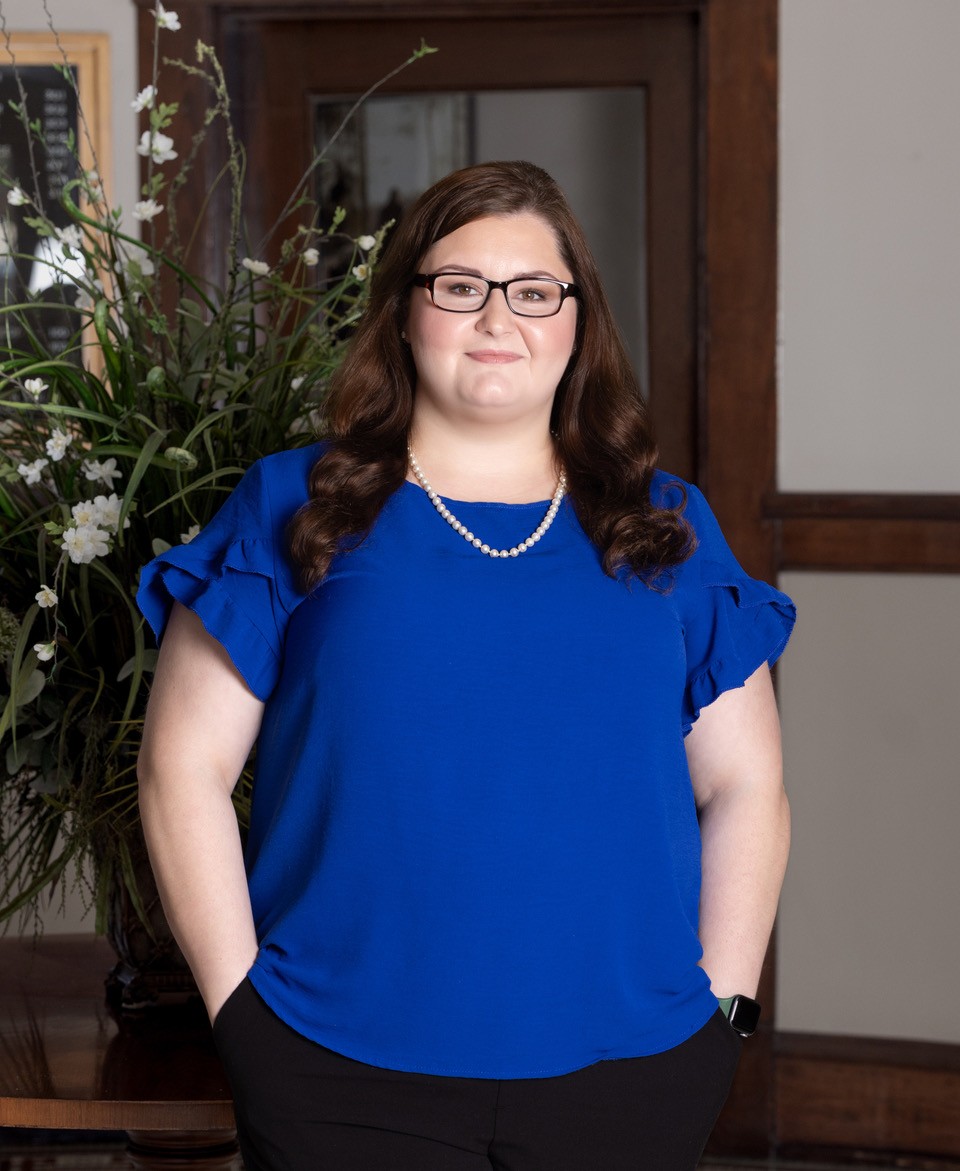
Delta Holloway has served the City of Laurel since 2018, beginning her career with the city as a Human Resources Assistant and now leading the department as Human Resources Director. Over the years, she has developed a comprehensive understanding of the City’s HR operations - including payroll, benefits, compliance, and employee support. Her expertise in these areas continues to shape her approach to leadership.
In her current role, Delta manages human resources and payroll functions for more than 60 city positions. She oversees recruitment and onboarding, policy development, benefits administration, and ensures compliance with local, state, and federal employment regulations.
Delta holds a Bachelor of Science in Interdisciplinary Studies from Delta State University and a Master of Jurisprudence in Labor & Employment Law from Tulane Law School. Her studies focused on employment law compliance, workplace investigations, employee rights, and policy development.
Her top priority is to support the city’s employees by fostering HR practices that are responsive, compliant, and transparent. She is committed to fostering a workplace culture rooted in fairness, accountability, and opportunity, and to supporting those who serve The City Beautiful each day.
Members of the Human Resources Department serve the city and its employees in a variety of ways including:
In addition to their duties in employee recruitment and retention, compensation, and compliance, the Human Resources Department also oversees the claims process when a person or organization files a claim against the city due to property damage when the individual feels that the city is the cause of the damage.
Individuals interested in filing a claim against the City of Laurel for damages to vehicles sustained while driving inside the city limits, may do so using the following process.
First, please be advised that the Mississippi Tort Claims Act, Section 11-46-9 of the Mississippi Code 1972, paragraph (v) states that, “A governmental entity and its employees acting within the course and scope of their employment or duties shall not be liable for any claim… arising out of an injury caused by a dangerous condition on property of the governmental entity that was not caused by the negligent or other wrongful conduct of an employee of the governmental entity or of which the governmental entity did not have notice, either actual or constructive, and adequate opportunity to protect or warn against; provided, however, that a governmental entity shall not be liable for the failure to warn of a dangerous condition which is obvious to one exercising due care.”
(For the full text, see Miss. Code Ann. § 11-46-9 .)
Secondly, in order to file a claim, an accident report must be filed with the Laurel Police Department. An on-scene report, where an officer is present, can be filed on the day of the accident. However, if the driver is unable to remain at the scene of the accident until an officer can arrive on-scene to create the report, a delayed accident report may be filed at the Laurel Police Department headquarters at 317 S. Magnolia Street, Laurel, MS 39440.
When filing an accident report, the claimant must present a valid driver’s license, proof of insurance, his or her address and telephone number, a description of the anomaly he or she believes caused the damage, their direction of travel, and approximate speed of travel when the incident occurred.
If the accident report is being filed at the police department, the claimant should also provide detailed information about the exact location of the anomaly.
Anomalies that drivers may encounter include potholes, cut-outs, wash-outs, and sink holes. See examples below:


Once the police report has been completed, the claimant may bring a copy of that report, a completed Liability Claim form, and one or two estimates to repair the reported damage to the city’s safety coordinator.
The safety coordinator will be able to review the claim, facilitate the claim including assignment and transfer of all forms and other paperwork between the claimant and liability carrier for the City; record the exact location of the anomaly and the damage claimed through photographs and incident reports, refer the claimant to a third party if necessary, investigate the validity of the claim, and work with the public works department and/or third party to establish responsibility for the anomaly.
For example, cut-outs are largely caused either by construction or utility companies. In the event that a vehicle is damaged by a cut-out, the safety coordinator would be able to assist the claimant in filing a claim with the third-party construction or utility company’s liability insurance provider. If that company has created a hazardous condition by not properly repairing an anomaly or by failing to warn the public about an existing anomaly, they are liable for the damages.
If a claim is submitted to and denied by a third-party company, the claimant may bring a copy of the denial along with a letter to explain why the claimant believes that the City of Laurel should be held responsible for the damages. This information will be forwarded to the city’s liability company for review.
Step 1: When the accident occurs, or as soon as possible thereafter, the claimant should contact the Laurel Police Department to file either an on-site police report or a delayed accident report. The claimant should provide a valid driver’s license, proof of insurance, his or her address and telephone number, the exact location of the anomaly that caused the damage, their direction of travel, and rate of speed when the accident occurred.
Step 2: The claimant should get one or two quotes from providers to demonstrate the anticipated cost of repairs.
Step 3: The claimant should download and complete the City’s Liability Claim form. The form can be found here.
Step 4: The claimant should submit a copy of the police report, the quotes from providers, and the completed liability claim form to the safety coordinator at City Hall.
Step 5: The safety coordinator will take photos of the damages and of the anomaly reported and will also contact the public works director to check if the anomaly has been previously reported.
Step 6: If the safety coordinator finds that the city may be liable for the damages, the safety coordinator will submit the claim to the city’s liability company, Mississippi Municipal Service Company. However, if the safety coordinator finds that a third-party company is responsible for the damages, the safety coordinator will refer the claimant to the third-party for resolution. If the third-party company denies the claim, the claimant may bring a copy of their denial along with a letter to explain why the claimant believes that the damages were caused by actions taken or not taken by the City of Laurel to the safety coordinator so that the safety coordinator may send the information to the city’s liability company.
Step 7: If the liability company approves payment of the claim, they, Mississippi Municipal Service Company, will issue a check for the damages. In order to receive the check, the claimant must sign a release form and have it notarized. The City is unable to directly compensate claimants, all claims must be submitted to and paid by the liability company.
It is also important to note that claims cannot be filed for vehicles with low-profile tires. Low-profile tires are tires that have a low aspect ratio.
For tires, an aspect ratio refers to the percentage of difference between the tire’s height and width. For example, if a tire is 245 mm wide, and the height of the tires’ side wall is 98 mm, the aspect ratio for that tire will be 40 because the height is 40% of the width.
Currently, tires with aspect ratios below 50 are considered low-profile tires.
Many in the automotive industry note that low-profile tires may make a vehicle easier to handle along straight, flat surfaces and they are frequently used on sports cars for this reason. However, low-profile tires are also more vulnerable to damage, wear faster, and lose air faster than their counterparts.